
Deep tissue · Downtown Asheville · 60 or 90 minutes

Deep is a direction, not a force.

Deep tissue massage in downtown Asheville, and not a separate service. It is Deep Restorative Massage™, the method behind every session in this room, read as deep tissue: settle the nervous system first, then slow, specific, sustained work that goes as deep as your body will genuinely allow. That is further than force ever gets. Deep is not the same as painful.

★★★★★ 5.0 on Google · 143 reviews Official massage partner of The Restoration Hotel 35 Haywood St · Suite 203
Caffeine-free masala chai poured through a strainer into a terracotta cup
The welcome pour. Caffeine-free, and yours to choose.
I

Arrive

Come a little early. You are welcomed at the door, your coat is taken, and a pour is offered: the house masala chai, which is caffeine-free, or herbal tea, or simply water. If you have come for deep work, say so at the door. It changes nothing about the first ten minutes, and the depth comes easier for them. A body that has arrived lets the work in. A body that walked straight from the street to the table guards against it.

The lounge corner: rattan sofa, brass arc lamp, a philodendron and two leather chairs
The lounge, one flight above Haywood Street.
II

The conversation

Before any hands-on work, a few minutes in the lounge: where the pain lives and how long it has lived there, what you have already tried, what a good session has felt like before and what a bad one did. Then the question that matters most on this page: how you know when pressure has gone from enough to too much, and the word you will use to say so. Some guests want to give notes the whole way through. Some want silence and one agreed signal. Both are correct.

This is also where the instruments are raised, if they might help, so nothing is a surprise on the table. And if something is newly injured, swollen or inflamed, say so here. Deep work waits for tissue that is ready for it; the session adapts around what is not.

III

The work, as deep tissue

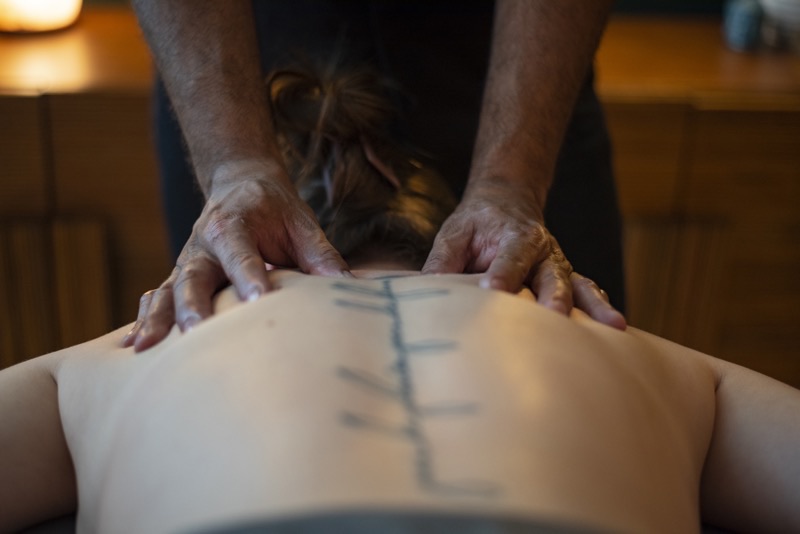
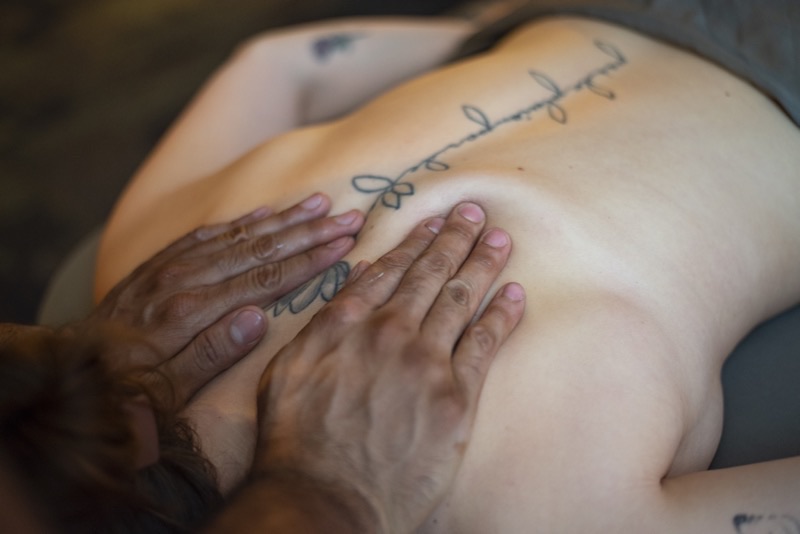
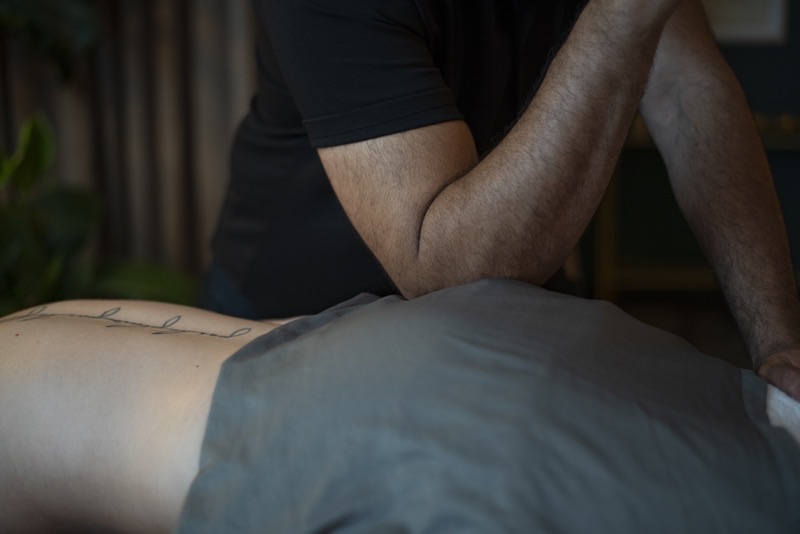
Deep Restorative Massage™ read as deep tissue is slow, sustained and specific. Pressure builds as the tissue allows, not as a clock demands. Your therapist follows the muscle as it yields rather than pushing through it, and stays with one region until it has actually changed instead of touring every region at the same depth. You set the ceiling, and it is read continuously, in your breath as much as in your words. A wince is information, not a goal. The depth this reaches is the depth your body agrees to, which is further than anything forced on it.

Hands pressing along a guest's forearm resting on the drape
The forearm, where the desk and the phone live
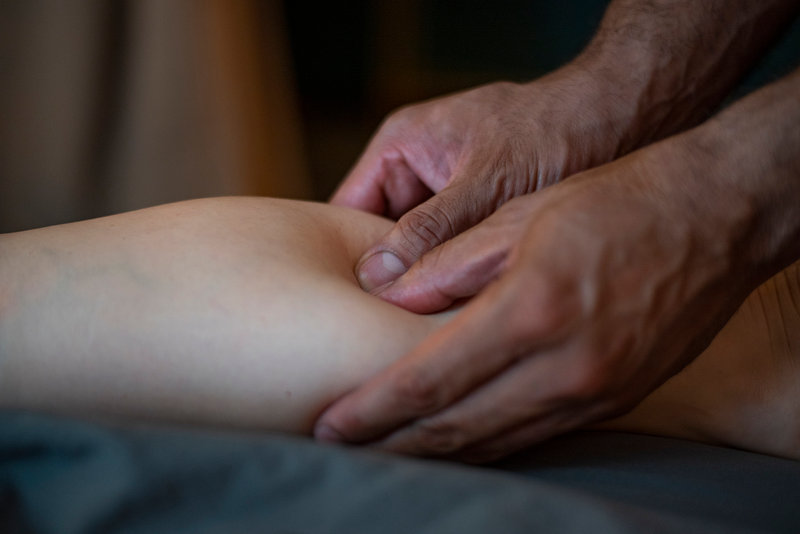
Arash holding a guest's raised leg at the ankle and calf, eyes on the work
The calf and ankle, for legs that stand, run or climb all day
Both thumbs pressed into the arch of a guest's foot
The arch of the foot, slowly, where the whole day lands
Thumb and fingers lifting tissue on a guest's upper arm
Lifting, not only pressing.
IV

The instruments

Cupping and myofascial instruments are available when your body calls for them. Your therapist will ask first; nothing is added without your yes, and nothing is charged for it.

Most bodywork presses. When a region will not let go under hands alone, two other tools change the conversation with it. Cupping lifts: gentle suction draws the tissue up instead of pushing it down, and a stubborn area gets a different kind of invitation. Myofascial scraping with stainless steel instruments finds what fingers miss: a smooth edge drawn slowly along the tissue, reading its texture, never forced. The cups can leave round marks for a few days, which is why you hear about them before you say yes. Either can stop the moment you say so, and the hands return.

The research on both is early and modest, and the research section below says exactly how modest. We use them because, in the right region, a guest feels the difference. The guest decides.

Arash warming oil between his palms before it touches a fully draped guest
Oil warmed between the palms before the deep work begins.
V

Warmth, then depth

Deep work goes further into a warm body than a braced one, so warmth comes first here and stays. Steamed towels, the jade stone ritual laid along the back before the deep work starts, a weighted thermal layer across the parts of you that are resting, and oil warmed between the palms. Warmth, weight and quiet are the signals a nervous system reads as safety, and safety is what lets the tissue be reached. Every ritual beyond the massage itself is optional, and each is offered rather than imposed.

VI

The close

The last minutes are as still as the first. A few resonant notes close the session, then quiet. You come up slowly, with a hand if you want one, and there is no hurry out the door: water, a moment to sit, the door held. Expect to feel slower for the rest of the day. After deep work, a mild soreness the next day can happen, as after a good workout; it is not proof of anything, and if it lasts longer than a day or two, tell us. Set aside about two hours for the 90 and about ninety minutes for the 60.

The room, between guests.
Deep Restorative Massage™ · read as deep tissue

Deep tissue describes a pressure. This method describes an order.

Deep tissue is not a separate item on the menu here. Every session in this room is Deep Restorative Massage™, Arash's method: settle the nervous system first, then the work. Asking for deep tissue changes what the third step does, and sharpens why the first two come before it.

1

Control the environment

Stays. One private room, one guest, one door that closes. Low, warm light, living plants, the sound of water, a warm table and soft linens.

Reads as. Warmth is set up before you arrive: the table warm, the stones ready for the back, the towels steaming before the deep work starts. The instruments are laid out only if you said yes.

2

Let the nervous system arrive

Stays. Nothing hands-on happens first. A pour if you would like one, then a real conversation before the table.

Reads as. What the conversation asks: where the pain lives, what too much feels like for you and the word you will use, whether you want the instruments offered. A body under stress guards its muscles before a hand ever touches them, and deep work into a guarding muscle is force meeting force. This step is where the guard comes down.

3

Then the work

Stays. Slow, sustained pressure the body meets instead of fighting, read continuously. Warmth to give the calm somewhere to land, and a close in sound and stillness.

Reads as. Specific and sustained, as deep as the tissue yields, one region until it changes. No counting to a number, no pushing through a wince. The cups or the instruments when a region calls for them and you have agreed. Deep is a direction, not a force.

Same welcome, same conversation, same close. The same method, read as deep tissue.

Every ritual beyond the massage itself is optional.

The method, in full →

The research

What the science supports, in plain words.

Deep tissue massage carries more folklore than most bodywork: adhesions broken, toxins flushed, no pain no gain. The trials say something quieter and more useful. Each finding below is linked so you can read it yourself, and where the evidence is thin, this page says so.

01

Depth did not beat settling for chronic back pain.

In the largest trial of its kind, 401 people with chronic low back pain received structural massage, relaxation massage or usual care. At ten weeks both massage groups had improved about equally, disability scores 2.5 to 2.9 points better than usual care, and the benefit lasted at least six months. The authors found no clinically meaningful difference between the two kinds of massage. That is the reason depth here follows the settling and never replaces it.

  • Cherkin DC, et al. (2011). A comparison of the effects of 2 types of massage and usual care on chronic low back pain: a randomized, controlled trial. Annals of Internal Medicine. PubMed
02

Pressure that lands turns the body toward calm.

In a small study of twenty adults, fifteen minutes of moderate-pressure massage shifted heart rate variability toward the parasympathetic, calmer side, while light pressure shifted it the other way. It is one laboratory and a small group, so this page treats it as a hint rather than a law. A later imaging study found that deep, steady pressure is felt as pleasant and calming and lights up much of the same brain circuitry as gentle stroking.

  • Diego MA, Field T (2009). Moderate pressure massage elicits a parasympathetic nervous system response. International Journal of Neuroscience. PubMed
  • Case LK, et al. (2021). Pleasant Deep Pressure: Expanding the Social Touch Hypothesis. Neuroscience. PubMed
03

A body under stress guards. Deep work runs into that.

Mental stress alone raised the electrical activity of the upper-back muscles in 62 women, with no physical load at all. Simply expecting back pain shifted the trunk muscles of healthy volunteers into a protective, stiffening pattern. And the emotional state a person brings to the table changes how the brain processes pain. Every one of those is a reason the conversation and the settling come before the depth.

  • Lundberg U, et al. (1994). Psychophysiological stress and EMG activity of the trapezius muscle. International Journal of Behavioral Medicine. PubMed
  • Moseley GL, Nicholas MK, Hodges PW (2004). Does anticipation of back pain predispose to back trouble? Brain. PubMed
  • Bushnell MC, Ceko M, Low LA (2013). Cognitive and emotional control of pain and its disruption in chronic pain. Nature Reviews Neuroscience. PubMed
04

What you expect changes what you feel under pressure.

Fifty-six healthy people were told to expect either a good or an unpleasant experience, then given a massage firm enough to hurt. Those set up to expect good things tolerated more pressure by the third and fourth minute than those set up to expect the worst. The conversation before the table is not a courtesy. It is part of how deep the work can go.

  • Wilson AT, et al. (2023). Expectations affect pain sensitivity changes during massage. Journal of Manual & Manipulative Therapy. PubMed
05

Slow is not a style. It is a speed the skin is tuned to.

A class of nerve fibers in the skin responds most strongly to gentle stroking at one to ten centimeters a second, the speeds people rate as most pleasant. That pathway answers gentle touch, not deep pressure, which is exactly why the deep work here is bracketed by slow strokes rather than starting cold, and why the pace never hurries.

  • Löken LS, et al. (2009). Coding of pleasant touch by unmyelinated afferents in humans. Nature Neuroscience. PubMed
06

One session, and a rhythm of them.

Across 37 randomized studies, a single massage lowered state anxiety, blood pressure and heart rate but not pain measured right afterward; a course of sessions reduced pain measured later, and its largest effects were on trait anxiety and depression. A stubborn region is usually a rhythm of sessions, not one heroic afternoon.

  • Moyer CA, Rounds J, Hannum JW (2004). A meta-analysis of massage therapy research. Psychological Bulletin. PubMed
07

The instruments, honestly.

A systematic review of seven randomized trials of instrument-assisted soft tissue work found no advantage over other care for musculoskeletal problems, and short-term gains in joint range of motion lasting up to a day. A review of cupping for pain found seven trials, several positive, most of poor quality, and called for better studies before anything is concluded. That is the evidence in full, which is why neither tool is sold here and both are offered only where a body calls for them.

  • Cheatham SW, et al. (2016). The efficacy of instrument assisted soft tissue mobilization: a systematic review. Journal of the Canadian Chiropractic Association. PubMed
  • Kim JI, et al. (2011). Cupping for treating pain: a systematic review. Evidence-Based Complementary and Alternative Medicine. PubMed
What we do not claim

Only what the evidence will carry.

Deep work here does not break up scar tissue, release fascia or flush lactic acid. The forces that would actually deform dense fascia are far beyond what hands can apply, and after hard exercise, massage was found to slow the clearing of lactate from muscle rather than speed it. Soreness the next day is not proof the work went deep; it is a sign of how much was asked of the tissue. What the evidence does carry is quieter and real: less pain and better function over weeks, a calmer nervous system within the hour, and a body that lets the work in instead of guarding against it.

Chaudhry H, et al. (2008), Journal of the American Osteopathic Association · PubMed  ·  Wiltshire EV, et al. (2010), Medicine & Science in Sports & Exercise · PubMed

Guest words
"He took the time to listen to my needs and was very responsive throughout the session. It was deeply relaxing while still providing all the benefits of a great deep tissue massage."Hana Johnson · Google · April 2025
"I deal with high stress and deep muscle pain from past injuries. Arash is highly attentive at focusing on relaxation and deep tissue massage."Andrea Epperson · Google · March 2025

Guests' own words, from their public Google reviews. Every body is different, and so is every session.

Sessions

Two ways in. Both go as deep as you allow.

Questions
Is deep tissue a separate service?

No. It is Deep Restorative Massage™, the same method behind the 90 and the 60, read as deep tissue. You reserve the 90 or the 60 as anyone would and say that you have come for deep work. The session is built from there.

Will it hurt?

Deep is not the same as painful. Pressure builds as your body allows, you set the ceiling, and it is read continuously in your breath as well as your words. A wince is information, not a goal. A mild soreness the next day can happen, as after a good workout, and it is not proof of anything.

How deep can you go?

As deep as the tissue yields. After the settling, that is usually further than force ever gets, because a body that has stopped guarding lets the work in. The therapist stays with one region until it has actually changed rather than touring everything at the same depth.

What are the instruments, and do they cost extra?

Cupping, which lifts the tissue with gentle suction, and myofascial scraping with stainless steel instruments, a smooth edge drawn slowly along the tissue. Both are available when your body calls for them. Your therapist will ask first, nothing is added without your yes, and nothing is charged for it.

Do the cups leave marks?

They can. The suction draws blood toward the surface and can leave round marks that fade over a few days. You hear about that before you say yes, and the cups are never used anywhere you would rather they were not.

Is deep tissue better than relaxation massage for back pain?

The largest trial to ask found that relaxation massage and structural massage did about equally well for chronic low back pain, with benefits lasting at least six months. That is why the settling comes first here and the depth is added to it rather than swapped for it.

Should I come in with a new injury?

If something is newly injured, swollen or inflamed, deep work waits, and it helps to check with your provider first. Tell us and the session adapts: the rest of the body still gets the work, and the injured region is left alone or treated gently.

The 60 or the 90?

The 90 if you can. Deep work needs the settling first and the time to go slowly, and the 90 leaves room for both without cutting the close short. The 60 goes deep in one region rather than everywhere.

As deep as your body allows, one flight up.

Rated 5.0 on Google across 143 reviews. Reservations online or by phone.

Reserve the 90 Reserve the 60